
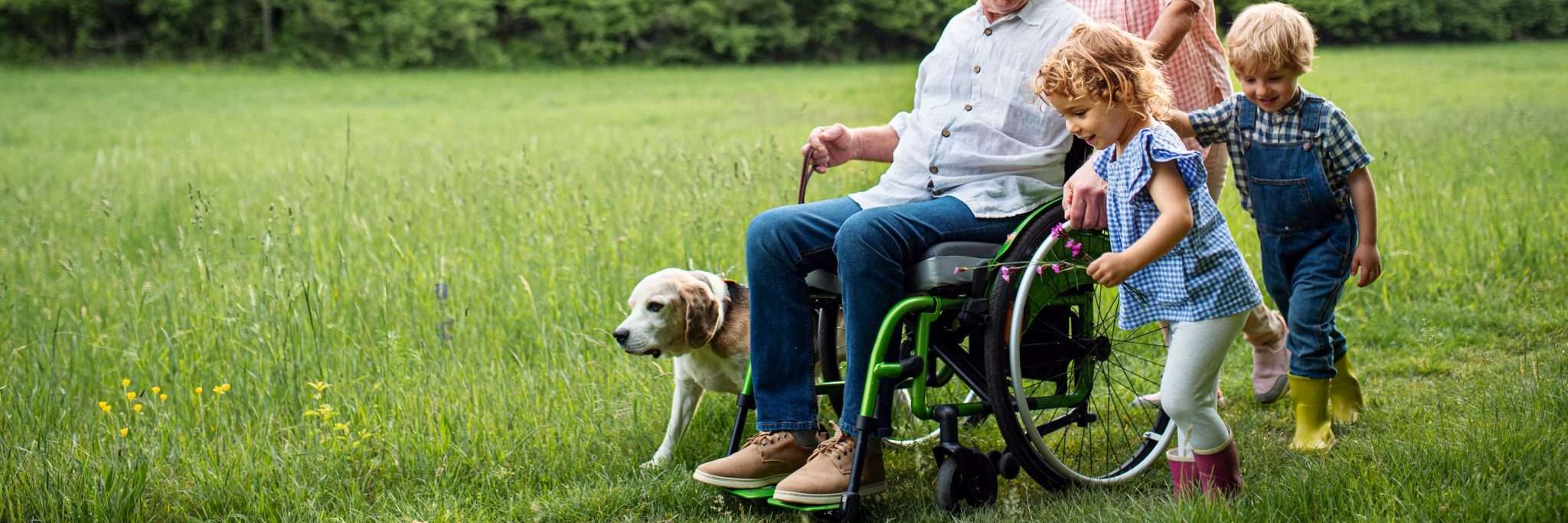
Creating accessible outdoor spaces is an important consideration for public parks, schools, care homes, visitor attractions and sports areas.
For locations that want to retain a natural appearance while improving accessibility, grass protection mats offer an effective solution for improving garden paths for wheelchair users. By strengthening the ground beneath foot and wheel traffic, grass mats can create stable, wheelchair-friendly routes without losing the natural feel of the landscape.
Why Grass Paths Can Be Difficult for Wheelchair Users
Natural grass surfaces can present several challenges for those with accessibility requirements. During wet weather, grass can quickly become soft, muddy and uneven, making it difficult for wheelchairs, mobility scooters and those with walking aids to move safely.
Repeated use can also create worn tracks where exposed soil and ruts can further reduce accessibility. These issues are common along frequently used routes and pathways.
Without reinforcement, even well-maintained gardens can struggle to withstand regular wheeled traffic. In a worst-case scenario, a wheelchair user could find themselves unable to access the area at all, so it’s important to make accessibility a top consideration.
The Problem With Loose Gravel and Dirt Paths
Loose gravel and dirt paths can present significant challenges for wheelchair users. Gravel creates rolling resistance that makes self-propelled wheelchairs harder to manoeuvre.
Dirt paths may appear firm in dry conditions but can quickly become muddy, uneven and difficult to navigate after rainfall. These issues can affect both manual and powered wheelchairs. Mobility aides could also contribute to the churning of the ground, exacerbating the problem.
Considering Different Types of Wheelchairs
Not all wheelchairs place the same demands on a pathway, so it’s important to consider how the route will be used when planning an accessible grass path.
Manual wheelchairs
Self-propelled wheelchairs require the smoothest possible surface. Even small bumps, soft patches or uneven ground can make it difficult for users to generate enough momentum to move comfortably. For these routes, ensuring level access and that the ground is well-drained is particularly important.
Attendant-propelled wheelchairs
Wheelchairs pushed by another person, such as a carer, can sometimes cope with slightly more challenging surfaces because an assistant is available to help navigate uneven areas. However, excessive slopes, muddy conditions and unstable ground should still be avoided for user comfort and safety.
Electric wheelchairs and mobility scooters
Typically heavier than manual wheelchairs, these can place greater loads on the ground surface. While their powered motors make them less dependent on a perfectly smooth route, they can cause further ground churn over time, particularly on soft or waterlogged ground. In these situations, grass protection mats may be beneficial to provide additional stability and prevent rutting.
It’s also worth considering the width of the pathway. Larger powered wheelchairs and mobility scooters often require more space to manoeuvre, especially where turns, passing places or access points are involved. Wider paths improve accessibility and make the route more comfortable for all users.
What Are Grass Protection Mats?
Grass protection mats are flexible, permeable rubber structures that are installed directly onto existing grass. Once fixed in place, the grass grows through the rubber matting, creating a reinforced surface that shows the natural grass, but with increased durability.
The mats help to distribute loads across a larger area, reducing wear and protecting the root structure beneath. This creates a firmer, more stable surface that is better able to support wheelchairs, mobility scooters, pedestrians and maintenance vehicles.
Unlike hard paving, grass mats preserve the natural look of the landscape while helping to prevent erosion and muddy conditions.
Choosing the Right Grass Mat
The best grass mat for a wheelchair accessible path will depend on the expected level of traffic and site conditions.
For pedestrian routes and garden paths, 16mm grass protection mats can provide an effective solution while allowing grass to continue growing naturally through the structure.
For areas that experience heavier use, such as public parks or visitor attractions, 22mm grass mats have increased durability.
Because the mats remain permeable, rainwater can continue to drain naturally into the ground rather than creating hazardous surface runoff or puddling.
Preparing the Ground for a Grass Mat
Before installing grass mats, the route should be carefully assessed. The ideal wheelchair-accessible path should:
- Feature-level access, following the flattest practical route
- Avoid sharp gradients where possible
- Be free from major depressions and trip hazards
- Provide sufficient width for wheelchair users
- Offer good drainage
Any significant holes, ruts or uneven areas should be levelled before installation. Improving the sub-base at this stage can greatly improve the long-term performance of the pathway.
Installing the Grass Mats
Grass protection mats are typically installed directly over healthy grass and secured using fixing pegs.
The mats should be laid tightly together to minimise movement and ensure a consistent surface to create level access. Once installed, the grass continues to grow through the matting, helping to integrate the mat into the surrounding landscape.
Over time, the reinforced route becomes increasingly discreet while continuing to protect against wear and rutting.
Grass Protection Mats on Wheelchair Ramps
Wheelchair ramps can be particularly vulnerable to wear, especially where they connect to grassed areas. Frequent use by wheelchairs, mobility scooters and pedestrians can quickly wear away vegetation, leaving muddy patches that make access more difficult and potentially hazardous in wet weather. Installing a grass protection mat on and around a ramp approach helps to protect the grass roots while creating a firmer, more stable surface.
Maintaining an Accessible Grass Path
One of the advantages of grass mat systems is that they require relatively little maintenance once established.
Regular mowing can continue as normal, and the reinforced grass remains visually attractive throughout the year. Periodic inspections should be carried out to check for any movement, damage or areas where additional support may be required.
A Natural Alternative to Hard Surfacing
Creating a wheelchair-accessible garden path does not always require concrete or extensive groundwork. Grass reinforcement mats provide a practical way to improve accessibility while preserving the natural character of a landscape.
Grass mats can create stable, durable and green routes that remain accessible for wheelchair and mobility scooter users throughout the year. For parks and public spaces, they provide an effective balance of accessibility, sustainability and visual appeal.

