
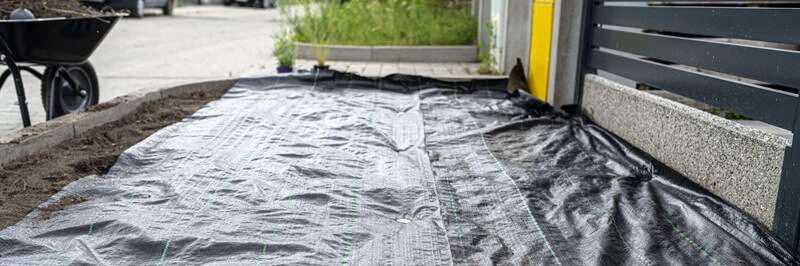
Geotextiles are an incredibly versatile material, serving as a cornerstone of many civil engineering and construction projects. Their multi-functional features can be integral to environmental protection and maintaining erosion control, particularly for frequently waterlogged areas.
What are Geotextiles?
Put simply, geotextiles are permeable synthetic fabrics that are typically installed to improve soil stability. They are placed in contact with soil, rock or other geotechnical materials to strengthen, separate, filter, drain or protect them. Different types include woven geotextiles, non-woven geotextile, and knitted geotextiles, and they can be constructed from polypropylene, polyester, or polyethylene.
Our non-woven geotextiles are specifically designed to improve the longevity and performance of soft ground in construction projects. As well as being useful for material separation purposes, they are also an excellent option for improving filtration, the general function of drainage systems and ground reinforcement. Our terram geotextile products are constructed via a needle punch process and are unwoven. This means they are highly permeable, and that granular material can easily be spread across the soft areas of the original ground.
Where Are They Used?
The versatility of geotextiles means they can be used in a number of places to facilitate various building projects.
Road Construction
During road or highway construction, geotextiles are usually placed between the subgrade and the sub-base or base layer with the fundamental purpose of separation.
During construction, soft subgrade materials like clay or silt move up into aggregate layers under traffic, particularly when wet. These permeable textiles serve as a barrier which prevent fines from migrating upward, and also maintain the thickness and strength of the base layers. This results in reduced rutting, improved pavement performance, and a longer service life.
Our Terram T1000 2.5m x 100m is a fully permeable stabilising and separation membrane that enables water to pass through freely but stops fine grains and other loose materials from mixing. With a tensile strength of 8 kN/M, it can be used in many applications including road and driveway construction, pedestrian walkways and land drains. Its high tensile strength means it minimises the need for excavation of the original ground.
Retaining Walls and Reinforced Soil Structures
From conventional retaining walls, to Mechanically Stabilised Earth (MSE) walls, as well as Reinforced Soil Slopes (RSS), and bridge approaches, geotextiles can provide several benefits.
On occasion water pressure can build behind a retaining wall and fine soil particles can wash into the drainage layers, clogging them. Geotextiles are placed behind the retaining wall between the drainage material and backfill soil. The addition of the material allows water to pass freely into the drainage zone, and fine soil particles are prevented from migrating. The results include long-term drainage performance, reduced hydrostatic pressure and increased wall stability.
Embankments and Slopes
Embankments and slopes can often fail as a result of weak or compressible foundation soils, excess water, and surface erosion from rainfall and water runoff.
Geotextiles are used on embankments when they are built on soft clay, peat or loose soil which are more vulnerable to the above. When geotextiles are installed here they are placed at the base of the embankment, directly on the foundation soil. The embankment load relies on the tensile strength of the geotextile. This works to improve load distribution, increase bearing capacity, and reduces the movement of soft soil.
Erosion Control
When wind or water removes soil, this can lead to slope instability as the soil stops supporting itself. To offset this, geotextiles are used. They act as a filter layer between the soil, preventing fine soil from being washed away while allowing water to escape safely for better soil stabilisation. This prevents bank undercutting and collapse, improves environmental management and increases the longevity of river training works.
Our Range
Like our grass mats and grass protection mesh, geotextiles are an invaluable resource for protecting surfaces, particularly when construction or engineering works are taking place. By investing in geotextiles, you are ensuring the integrity of your landscape fabric during the completion of any construction or environmental project.
For information and advice about our geotextiles, contact a member of our friendly team today.

